
There’s a reason wood stoves never went out of style — and it’s the same reason people still love a real wood-burning fireplace.
No gas bill. No electric grid to lose in a storm. Just a firebox, some seasoned wood, and heat that doesn’t quit until the fuel does.
They’re also not simple appliances you grab off a shelf without thinking.
Burn rate, emissions certification, BTU output, material — get any of these badly wrong and you end up with a stove that smokes up the living room or can’t actually heat the space you bought it for.
This guide covers what actually matters when buying one, plus five stoves worth a look right now.
Should You Get One?
A wood stove is a self-contained heating appliance, and a good one changes how a house feels through winter — not just warmer, but warmer in that specific, hard-to-fake way only a real fire manages.
Prices range from a few hundred dollars for a small stove to well over a thousand for a large cast-iron model, so the right budget depends entirely on how much space you’re heating and how often.
Below: what to actually check before buying, five current stoves worth considering, and answers to the questions that come up most.
Things to Look For When Buying a Wood Stove
A wood stove is a bigger commitment than most home appliances — it’s semi-permanent, it needs proper clearance and venting, and the “right” one depends heavily on your specific house. A mobile home, a two-story house, and a single-room cabin all want different stoves.
Here’s what to actually check.
Burn Time
Burn time — how long a loaded stove keeps producing usable heat — depends on the stove’s design, but also on your wood: dry, properly seasoned logs burn slower and cleaner than wet ones, which mostly just hiss and pop without much heat to show for it.
Look for at least 5–6 hours of burn time on a full load. Anything less and you’re feeding the fire every couple of hours, which gets old fast in January. If you’re not sure what counts as properly seasoned firewood, that’s worth sorting out before burn time becomes a mystery you can’t solve.
Emissions Certification
Every wood stove sold in the U.S. has to meet EPA emissions standards, and this isn’t a minor bureaucratic footnote — it’s the difference between a stove that burns wood efficiently and one that just makes smoke. Since 2020, new stoves have to meet a particulate limit of 2.0–2.5 grams of smoke per hour, tighter than the older 4.5 gram standard many buying guides still quote. Check that any stove you’re considering carries current EPA certification — it’s listed on the spec sheet, not something you have to guess at.
BTU Output and Sizing
BTU (British Thermal Units) measures heat output, and bigger isn’t automatically better — an oversized stove in a small room means opening windows in February to cool off, which defeats the entire point. Work out the BTU math for your actual room before shopping, rather than buying on room-count guesswork.
Worth a look either way: double barrel stoves, which squeeze extra efficiency out of a simple design.
Efficiency
Older wood stoves didn’t care much about efficiency; modern ones are built around it, with baffles, secondary air systems, and better insulation all doing real work. A genuinely efficient stove burns hotter and longer per log — 70% efficiency or better is the benchmark worth shopping for.
Whatever you buy, get the clearance and hearth-pad requirements right — what goes behind a wood stove is a fire-safety question, not a decorating one, and it ties directly into whether a stove is truly airtight or just marketed that way.
Material
Material affects how a stove heats, not just how it looks:
- Cast iron: the classic choice — heavy, durable, and it holds heat well after the fire dies down.
- Steel: heats up and cools down faster than cast iron, and tends to be lighter and less expensive.
- Soapstone: absorbs heat slowly and radiates it back over a long stretch — a genuinely different heating character, not just a look.
- Limestone/masonry: built more for appearance and thermal mass than fast heat, popular in stoves designed to be a room’s focal point.
Worth Adding
A few accessories that pull real weight: a firewood rack, an ash vacuum, a creosote remover, and a child safety screen if that’s relevant to your household — see our fuller rundown of fireplace accessories and tools for the rest.
Types of Wood Stoves
- Non-catalytic: simpler, quicker to start, and generally less maintenance — some internal parts do wear out and need replacing over the years.
- Catalytic: uses a coated ceramic combustor to burn hotter and longer per load. The combustor itself typically needs replacing after several years of use.
- Pedestal: sits on a base rather than legs, works in a range of room styles, and comes in enough finishes to match most décors.
- Freestanding: stands independently in a room, radiates heat in every direction, and needs proper floor protection underneath.
- Inserts: drop into an existing fireplace opening rather than standing alone — the retrofit option if you already have a fireplace cavity.
If wood itself isn’t the fuel you’re set on, pellet stoves are the other common option worth a look — different fuel, different maintenance rhythm, similar end result.
- For heating a large home: a 2,500 sq. ft. pedestal wood stove is built for serious square footage.
- For a mid-size room with fan-assisted heat: a 1,200 sq. ft. stove with a built-in blower pushes warm air further into the room.
- For a smaller, EPA-certified stove: a 900 sq. ft. EPA certified cast iron stove fits tighter spaces without cutting corners on emissions.
- For a cabin or small structure: a compact mini wood stove is sized for genuinely small spaces.
The 5 Best Wood Burning Stoves Right Now

- HEATS UP TO 900 SQ. FT.: This indoor wood burning stove delivers reliable, efficient heat for small to medium living spaces


- 🔥Detachable Chimney Design :In order to facilitate portability,wood Burning Stove is divided into 7 sections, which are composed of 7 chimney sections with a length of 12 inches in diameter. They can be assembled to the height you want. One of the chimney pipes has another Install dampers to manage flame size and burning rate

- OUTDOOR WOOD STOVE – We designed our camp stove for use outside. Ideal for use during camping trips or in your backyard. Whether heating or cooking, the wood burning stove does it all!

- FREIGHT SHIPPING: THIS ITEM SHIPS VIA LTL FREIGHT CARRIER VALID PHONE NUMBER OR EMAIL ADDRESS IS REQUIRED FOR DELIVERY

- Constructed from superb-quality stainless steel, this portable wood burning stove is engineered for exceptional durability and longevity, making it a reliable choice for any outdoor enthusiasts.Its robust design allows users start fires quickly while promoting efficient combustion, comes 7 chimney pipes facilitates proper ventilation by directing combustion gases outside, thereby enhancing safety.
Wood Stove Comparison
| Stove | Coverage | Material | Notable feature | Best For |
|---|---|---|---|---|
| Ashley Hearth AW2520E-P | 2,500 sq ft | Not stated | Pedestal base | Large homes |
| US Stove US1100E-BL | 1,200 sq ft | Not stated | Built-in blower | Mid-size rooms |
| Comfort Glow Cast Iron | 900 sq ft | Cast iron | EPA certified, cooking surface | Smaller EPA-certified pick |
| Cleveland Iron Works Mini | Not stated | Not stated | Compact size | Cabins, small structures |
| Smokeless Gasifier Dual-Fuel | Not stated | Not stated | Burns wood or coal | Fuel flexibility |
“Not stated” means the seller’s current listing doesn’t specify that detail — check the listing directly before buying if it matters for your use.
1. Ashley Hearth AW2520E-P Pedestal Wood Stove
Best for: large homes
Rated to cover 2,500 square feet, this is the pick if you’re heating a genuinely large space rather than a single room. It sits on a pedestal base rather than legs, which some buyers just prefer aesthetically.
The size that makes it capable of heating a big house is the same size that makes it a poor fit for anything smaller — don’t buy this one for a den.
- 2,500 sq. ft. rated coverage — genuine whole-house potential
- Pedestal design
- Overkill — and inefficient overkill at that — for a small room
- Listing doesn’t specify body material
2. US Stove US1100E-BL with Blower
Best for: mid-size rooms
Rated for 1,200 square feet with a built-in blower to push heat further into the room instead of just radiating it locally — genuinely useful in a larger single room or an open floor plan where heat needs help traveling. If a stove you like doesn’t come with one, blower kits can usually be added after the fact.
- Built-in blower circulates heat further
- 1,200 sq. ft. rating suits mid-size rooms well
- A blower means one more electrical component that can eventually fail
3. Comfort Glow Cast Iron EPA Certified Stove
Best for: a smaller, EPA-certified pickCast iron, EPA certified, rated for 900 square feet, and it includes a cooking surface on top — a genuinely useful extra if you’d ever boil water or keep a pot warm during a power outage. Fits up to 22-inch logs.
- EPA certified
- Cast iron construction
- Cooking surface on top
- 900 sq. ft. rating won’t stretch to a large home
4. Cleveland Iron Works Mini Wood Stove
Best for: cabins and small structures
A genuinely small stove for a genuinely small space — a cabin, a workshop, a tiny home — rather than a scaled-down claim on a stove that’s still too big for the room.
The current listing doesn’t spell out coverage or BTU figures, so confirm those directly if you need a specific number.
- Genuinely compact — suits small structures well
- Coverage and BTU not stated — confirm before buying
- Not intended for whole-house heating
5. Smokeless Gasifier Dual-Fuel Stove
Best for: fuel flexibility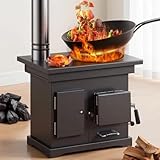
The odd one out on this list, and worth it for that reason: it burns either wood or coal, using gasifier technology aimed at cleaner combustion than a traditional firebox. Worth a look if fuel flexibility matters to you or wood availability is inconsistent where you live.
- Works with either wood or coal
- Gasifier design aimed at cleaner combustion
- Less established brand than the other picks here
- Coverage/BTU not stated — confirm before buying
FAQ
The Bottom Line
Wood stoves earn their reputation honestly — real heat, no utility dependency, and a look nothing else quite replicates. Match the coverage rating to your actual space, confirm current EPA certification, and don’t skip the clearance and venting requirements just because the stove looks straightforward to set up.
Product availability and pricing on Amazon shift constantly, so the picks above reflect what’s actually in stock right now, and the live listings throughout this page will update themselves if that changes.

Hi, my name’s Eugene Duke and I love sitting by my fireplace reading a book and sipping on an adult beverage. Do you have a fireplace in your house? I’ll help you figure out the best type and style of fireplace for your home.